


How to Stop Your Klaviyo Flows From Sending Conflicting Emails
By Trayan Hristov · Thrivelia · 20 October 2026
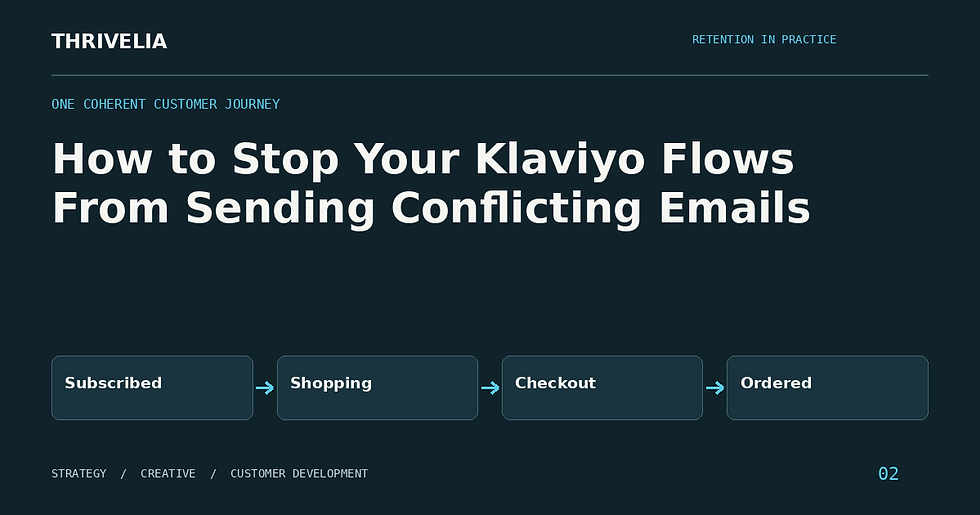
A subscriber joins your list, opens the welcome email, browses a product and starts checkout. By that evening they can qualify for several automations, each with a different story and possibly a different offer. Every individual flow can look sensible while the combined experience makes very little sense.
The fix is to define which customer state takes priority and what should happen when that state changes. Start with one person’s timeline across the account. A flow-by-flow review alone will miss the collision.

What Printfresh and Olive + Crate had to resolve
At Printfresh, welcome logic was designed to pause or stop when a customer showed stronger purchase intent, such as starting checkout. Abandonment journeys could take priority. The goal was to avoid simultaneous messages pulling the same person in different directions.
At Olive + Crate, the account review found duplicated abandonment logic, inactive legacy automations and journeys competing with cross-sell or nurture. The work included reviewing and pausing redundant or conflicting paths, then rebuilding around each journey’s purpose.
These examples support a practical operating principle: adding another flow requires a decision about what it replaces, interrupts or leaves alone. A longer flow list does not explain the customer experience.
Write the customer-state hierarchy in plain language
Use the following as a starting design to adapt, rather than a universal rule to copy. Service communication and essential order information need their own ownership and eligibility. A purchase should change promotional recovery, but it should not accidentally remove information the customer still needs about the order.
Customer state | Useful next message | Promotional conflict to resolve |
Subscribed, no purchase intent recorded | Brand and product introduction | Unrelated recovery or repeated signup incentives |
Browsing a specific product | Relevant product explanation | Generic content that ignores the current decision |
Checkout started, order not completed | Checkout help and a valid return path | Competing browse reminders or a different welcome offer |
Order completed | Order support and product adoption | Messages claiming the same order is still abandoned |
Product received or adopted | A relevant next product when appropriate | A generic “buy again” message before the first experience is resolved |
The exact priority depends on the product and available signals. A person can still benefit from brand education after starting checkout. The question is whether that message adds useful information or repeats the same sales request. Document exceptions so they remain deliberate.
Inventory what is actually sending
List the active flow, trigger, audience, delay, offer, current-state checks and owner. Include older versions and apps that still send. For each flow, pull several recent recipient timelines and inspect the messages alongside campaigns. A clean diagram is not evidence that a legacy journey stopped delivering.
Then ask what changes after a browse, checkout, order, cancellation or support issue. Does that event reach the account? Which later actions use it? Is the check attached to the whole journey or only one message? Those details determine whether the hierarchy exists in practice.
Put each rule at the level where it belongs
Klaviyo distinguishes event-specific trigger filters from profile filters. Its trigger and filter guidance explains that profile filters are evaluated at entry and again before flow actions. Failing a filter can skip an action; do not assume that every skip removes the profile from the entire flow.
An additional email filter targets a particular message. A split creates a different path. Use the distinction to express the customer decision, then test the result. Avoid placing every rule in one complicated condition that the next builder cannot explain.
For example, entry can be limited to the relevant product context, while a later promotional action checks whether a subsequent order makes it unnecessary. A product-care message may remain useful after another purchase. Give that message its own decision rather than blindly applying a sales exclusion to everything.
Treat incentives as one policy
A flow conflict is often an offer conflict. Someone can see a welcome incentive, a recovery code and a site-wide promotion within hours. Write one policy for eligibility, expiry, product exclusions and combinations. Then place test orders to confirm that the checkout behaves as the messages promise.
Use a different message when the same customer already has the best available offer. Repeating another code rarely answers the unresolved question. Fit, delivery, product selection or payment confidence may matter more than a larger discount.
Test a timeline, not just an email preview
Subscribe through the real form and confirm the intended welcome path.
Browse, then start checkout during a wait. Check which later messages remain eligible.
Purchase before the first recovery message, then repeat the test between messages.
Place a second order during post-purchase follow-up and inspect the next recommendation.
Test a suppressed profile, an unavailable item and a customer with an active promotion.
Record the observed route and any message that contradicts the latest customer state.
Agree how people already waiting in old flows will be handled before releasing a replacement. Keep the change time, tested scenarios and rollback owner together. Review the first live recipients after launch, because a correct preview cannot prove the event and timing logic.
Measure whether the journey improved
Track contradictory messages and duplicate reminders alongside purchasing, unsubscribes and complaints. If delivery volume falls, review revenue per delivery and customer progression as well as total revenue. Less overlap can be useful without justifying a claim that all later sales were caused by the cleanup.
This article focuses on conflicts inside the lifecycle programme. If two different platforms own recovery, use our Shopify and Klaviyo recovery guide. For implementation planning, use the practical Klaviyo flow guide.
Should checkout always stop the welcome flow?
Decide which welcome messages still help the customer. A checkout can make a generic purchase prompt redundant while brand or product education remains useful. Define that hierarchy and test the later actions rather than applying a blanket rule without reviewing the content.
Will Smart Sending solve conflicting journeys?
Frequency controls can help manage volume, but they do not define which offer, product or customer state should take priority. Review the actual message eligibility and the account’s configuration alongside any frequency settings.
Our home and living guide shows how to make those decisions relevant to a considered purchase. Explore Thrivelia’s services for help rebuilding the surrounding programme.

Comments